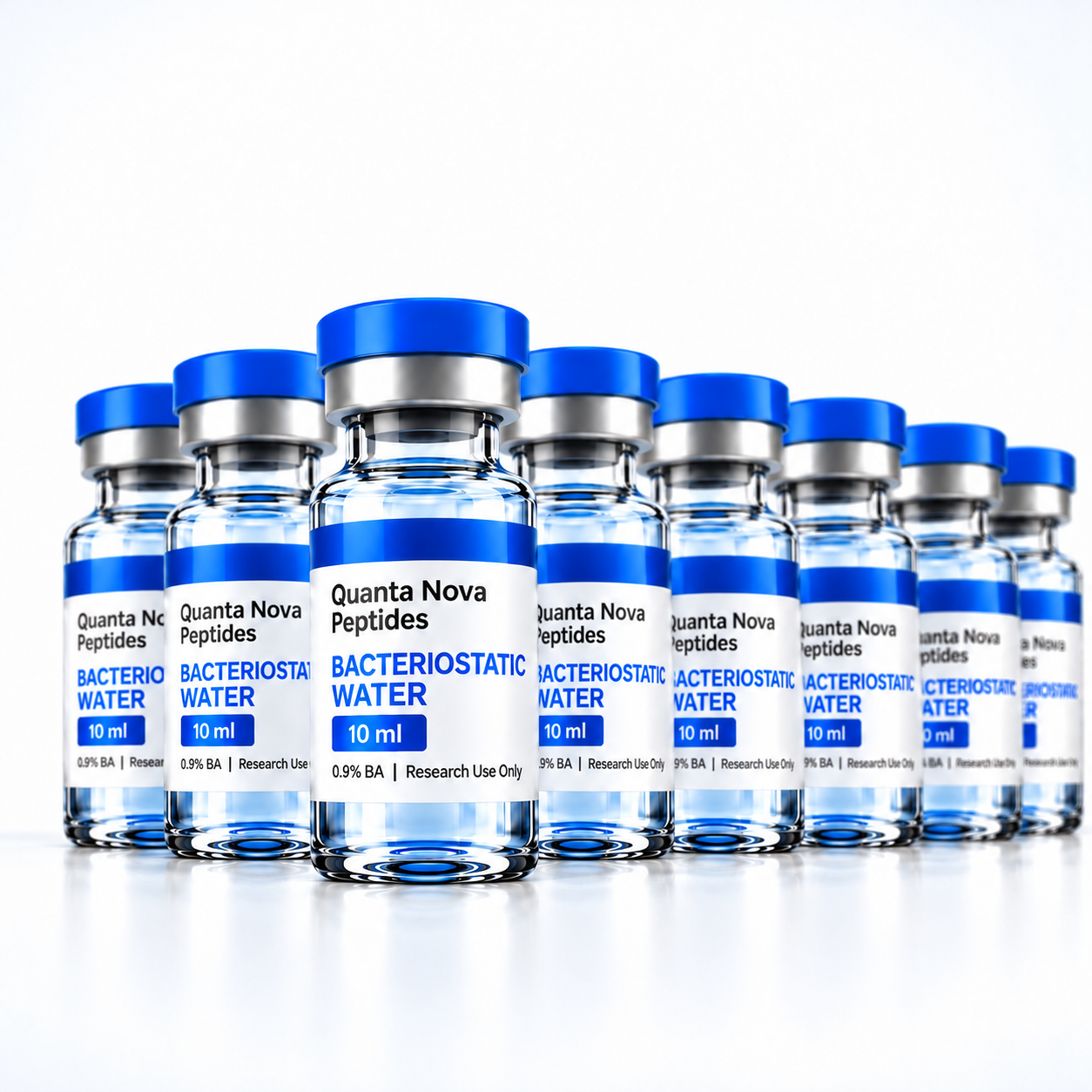
Bacteriostatic water is sterile water that contains a small amount of benzyl alcohol as a preservative, typically 0.9%. Research labs use it as a diluent in nonclinical dilution and reconstitution work, where a vial may be accessed more than once during a planned procedure.
That short answer covers the basics, but the details decide whether a product is dependable. Water grade, filtration, packaging and testing all shape quality. This guide explains each piece in plain language, using the published specifications of one documented manufacturer as a working example.
What Does the Word Bacteriostatic Actually Mean?
The term describes a substance that inhibits bacterial growth rather than killing bacteria outright. In a preserved liquid, the preservative slows microbial growth after the container has been opened.
In this product, the preservative is benzyl alcohol. The manufacturer, Quantum Innovation Labs in Garland, Texas, formulates its solution with a target concentration of 0.9% benzyl alcohol in Type I ultrapure water.
So the word is not marketing language. It points to a specific ingredient at a specific target level.
How Is It Different from Plain Sterile Water?
Plain sterile water contains no preservative, so it is generally treated as a single session liquid. Preserved water supports repeated access under clean handling. The right choice depends on what your protocol requires.
How Is Bacteriostatic Water Made?
Production is a sequence of controlled steps. Here is the path described by the manufacturer.
- Ultrapure base. Type I water forms the foundation.
- Preservative addition. Benzyl alcohol is formulated to a 0.9% target.
- Membrane filtration. The solution passes through 0.22 µm polyethersulfone (PES) filters.
- Glass packaging. The liquid is filled into Type I borosilicate glass vials.
- Independent testing. An accredited laboratory tests each batch before release.
Each step answers a specific risk. Pure water limits contaminants, filtration polishes the liquid, glass protects the formula and testing confirms the outcome.
Why Is the Solution Unbuffered?
The product is described as unbuffered, which means it contains no pH buffer. That keeps the formula simple, but it also means the container matters. Borosilicate glass resists chemical and hydrolytic attack, which helps minimize ionic leaching and potential pH changes.
What Should You Look for on the Label?
A good label gives you facts, not slogans. Check for these items.
- The preservative and its concentration
- The volume of the vial
- The batch number
- The manufacturer's name
- A clear statement of intended use
For this product, intended use is stated plainly: nonclinical laboratory dilution and reconstitution applications, for research use only.
How Do You Read a Certificate of Analysis?
A COA is a batch specific report of laboratory results. For a preserved diluent, two numbers usually matter most: benzyl alcohol content and pH.
A published report for one Quanta Nova batch lists benzyl alcohol at 1.03% and a pH of 5.9, along with the report number and test date. Read the batch number first, confirm it matches your vial, and then review the measured values.
Can You Verify a COA?
You should be able to. The company states that the COA for your order is posted online and can be checked against the independent laboratory's record. Selected reports also include a link to an outside verification service. That makes the report something you can audit instead of something you simply accept.
To see how a documented product page presents these records, look at a transparent source of Bacteriostatic water and compare its details with this guide.
Why Does Independent Testing Matter?
Testing by an outside party removes the conflict of interest. The company states that every batch is tested by an ISO/IEC 17025 accredited laboratory before release.
That accreditation means the laboratory's methods and competence have been assessed against an international standard. As a result, the figures on its reports are more credible than numbers from an unreviewed internal check.
What Pack Sizes Are Available?
The product line includes 3 mL and 10 mL vials in multi packs, with pricing that starts as low as $21.99. Larger formats are also listed, and a wholesale page exists for bigger needs.
Choose based on how often you open new vials. Smaller formats reduce leftover liquid on short projects, while larger ones suit steady, high volume work.
What Handling Habits Protect Quality?
Even excellent products depend on good technique. Follow your laboratory's own procedures, and add these habits.
- Label every vial with the date first opened.
- Record the batch number in your log.
- Inspect for clarity and particles before each use.
- Keep the liquid in its original glass vial.
- Set aside any vial that looks compromised.
What Is the Intended Use?
This content concerns laboratory research only. The product is not intended for any other purpose.
Conclusion
Bacteriostatic water is a preserved laboratory diluent, built on ultrapure water, a 0.9% benzyl alcohol target, 0.22 µm filtration and borosilicate glass. Its quality shows up in documentation: a batch number, an independent ISO/IEC 17025 test report and a COA you can verify.
Understand those pieces, and you can choose a supplier with clarity instead of guesswork.
FAQ
What is bacteriostatic water?
It is water with a preservative, usually benzyl alcohol, designed to inhibit bacterial growth in a vial that is opened more than once.
What concentration is used here?
The target is 0.9% benzyl alcohol.
Is it buffered?
No. The solution is unbuffered, so the vial material matters for pH stability.
What does the COA show?
Batch specific results such as benzyl alcohol content and pH, plus the report number and test date.
Is it for human use?
No. It is for laboratory research use only.